
The heart of Zen Buddhism
Among the many currents of Buddhism, Zen is known for emphasizing teaching through the practice of zazen, seated meditation.
Master Deshimaru taught precisely this practice, that is to say, the posture of the body, the posture of the mind, breathing, and initiated his disciples to the study of texts, notably those of the patriarchs of the lineage.
He also transmitted the context to keep so that this practice does not turn into gymnastics or a wellness technique: the appropriate clothes, the ceremonies, the chants, the rituals in the dojo, the place of practice. Master Kosen has, in turn, transmitted this treasure to us.
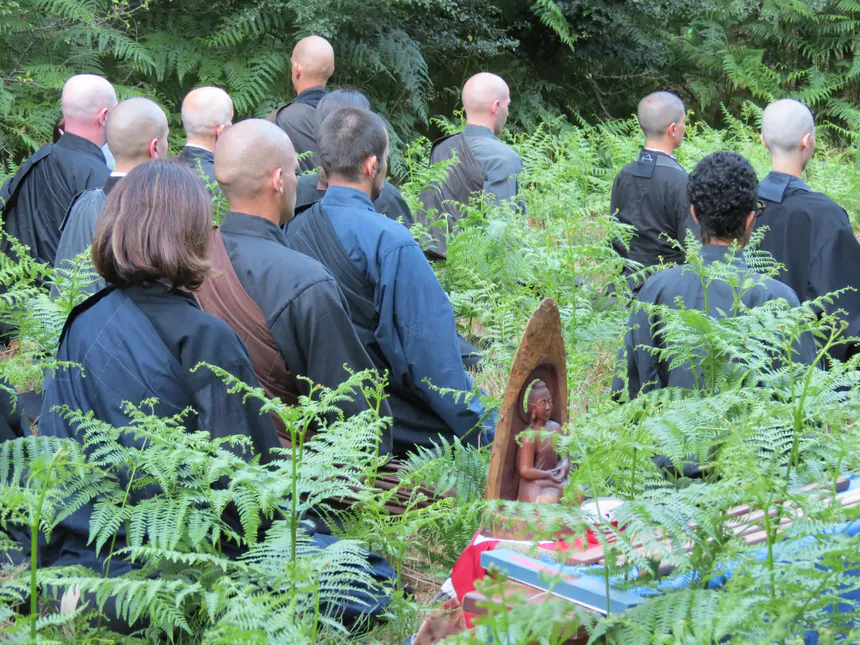
Today, Zen is still perceived by the majority of Westerners as something exotic and a bit folkloric. It is given a Japanese or Chinese image. But what about its integration into our culture and even more, into the new global culture? What fruits will spring from it?
To learn more about Zen and its arrival in the West, discover the history of Zen.
How to practice Zen meditation, zazen
Zazen is difficult, I know. But, practiced daily, it is very effective for the expansion of consciousness and the development of intuition. Zazen not only releases great energy, it is a posture of awakening. During its practice, one should not seek to achieve anything. Without an object, it is only concentration on the posture, breathing, and the attitude of the mind.
Master Taisen Deshimaru
To learn the posture, the most accurate way is to go to a dojo or to do a retreat, called sesshin (touching the mind). An experienced person in the practice will help you understand all the points to respect for a good taking of the posture.
Practicing in a group will help you maintain concentration. The teacher, the godo, will show you how to focus on the present moment and not let yourself be carried away by your thoughts.
The posture
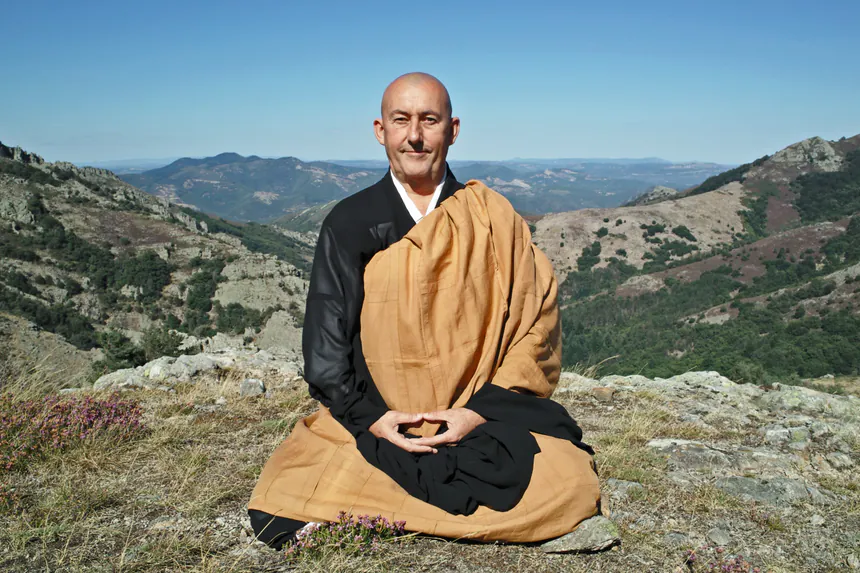
Sitting in the center of the zafu (round cushion), cross your legs in lotus or half-lotus. If you encounter an impossibility and can only cross your legs tailor-style, still anchor your knees in the ground, in order to straighten the spine well.
Tilt the pelvis forward at the level of the fifth lumbar vertebra. With the spine well erected, chin tucked in and thereby, the back of the neck stretched, the nose vertically aligned with the navel, push the earth with the knees and the sky with the top of the skull.
The role of the zafu in the posture
The meditation cushion, the zafu, is a key element for taking the correct posture. It helps to have the tilt of the pelvis necessary for balance during zazen. Each person shapes their zafu according to what is necessary for them to arrive at this right posture.
Be sure to release all tensions from every part of the body (back, arms, legs, neck, belly) in order to let the energy circulate freely and the breathing happen fully, quietly.
The placement of the hands
Another key point to have the exact posture is that of the hands. The left hand rests in the right hand and the thumbs join just above the palm of the hands. The thumbs have the necessary horizontality when the pulp of the middle finger of the right hand is in contact with the second joint starting from the tip of the middle finger of the left hand.
The contact of the thumbs is subtle. Imagine rolling a small grain of sand between your thumbs, tells us Master Kosen. The edge of the hands is in contact with the lower abdomen, below the navel, not too low. If you practice the lotus or half-lotus, the hands touch the heel of the foot that is on top. Be careful that the hands do not fall forward and not to create tension in the hands, arms, or shoulders.
This posture of the hands is what is called a mudra. It is the universal mudra: Hokkai jo in.
Breathing
Zen breathing is comparable to no other. Very ancient, it was called in Sanskrit Anapanasati
, it can only arise from a correct posture.
It aims above all to establish a slow, powerful, and natural rhythm, based on a soft, long, and deep exhalation. You release the air slowly and silently through the nose, while your exhalation descends powerfully into the belly. At the end of the exhalation, you inhale naturally.
The masters compare the Zen breath to the mooing of a cow or the exhalation of a baby, who cries as soon as born.
The attitude of the mind

Zan Maicalligraphy by Master Ryurin Desmur.
Sitting in zazen, let the images, thoughts, mental formations arising from the unconscious pass like clouds in the sky – without opposing them, without clinging to them.
Like reflections in a mirror, the emanations of the subconscious pass, pass again, and vanish. And you arrive at the deep unconscious, without thought, beyond all thought (hishiryo), true purity.
This attitude of mind flows naturally from a deep concentration on the posture and breathing. The improvement of cerebral circulation allows you to control your mental activity.
The simplicity of the posture
During zazen, the cortex (seat of conscious thought) rests, while the blood flows to the deep layers of the brain which, better irrigated, awaken from a half-sleep. Their activity gives an impression of well-being, serenity, calm, triggering, while fully awake, the deep sleep brain waves alpha
and theta
(see on this subject the studies done at Komazawa University in Japan).
Zen is very simple, and at the same time very difficult to understand. It is a matter of effort and repetition – like life.
Simply sitting, without a goal or spirit of profit, if your posture, your breathing, and the attitude of your mind are in harmony, you understand true Zen, you grasp the Buddha nature.
Walking meditation, kinhin
This walk is generally practiced between two sittings.
Master Kosen also recommends it if in your daily life, you feel stressed or need to take a break from your work.

How to practice kinhin
Left thumb enclosed in the left hand, all the fingers of the left hand are well closed on this thumb, up to the little finger. The root of the left thumb is on the solar plexus, a point located just below the sternum. The right hand encompasses the left hand. Arms horizontal (palms facing down), shoulders relaxed, upper body open.
The upper body is like in zazen, spine erected, chin tucked in, back of the neck stretched, the top of the skull pushes towards the sky. Eyes half-closed, gaze at 45º.
The feet are spaced the width of a fist apart. They point forward, slightly to the side, but not too fanned out.
Kinhin begins with an exhalation identical to that of zazen. The rhythm of breathing is the same as that of zazen.
At the end of the exhalation, let the lungs fill with air through the nose, naturally. When the body has lightened, advance the right foot by a small step, the length of half a foot. Then exhale gently, imperceptibly, down into the lower abdomen by progressively carrying the weight of the body on the front leg. This one is stretched, while the back leg relaxes. However, keep the contact of the back foot with the ground.
Inhale again and advance the back foot. During the exhalation, pay particular attention to the root of the big toe of the foot that is forward.
Where to practice?
To practice correctly, the place also has its importance. The dojo is, obviously, the privileged place, due to its tranquility and the atmosphere that emanates from it.
If you also wish to practice at home, find a quiet space, a piece of wall in front of which you can sit, so as not to be disturbed and not to disturb. An incense stick will bring a conducive atmosphere. If you are a beginner, prefer short practices of about ten minutes and favor the quality of zazen over its quantity.
The role of the kyosaku in the practice
When you come to the dojo or a retreat, everything you need to know is explained to you upon your arrival. You can receive the kyosaku, the awakening stick, which intrigues many people who have seen the use of this object in a documentary.
The kyosaku is given to anyone who requests it during the practice. It is of great help to regain beneficial concentration when you are too mentally or physically agitated, or too sleepy. The blows are applied on the trapezius of each shoulder, a point which, as anyone with a little knowledge of Chinese medicine knows, is a crossing of several meridians, energetic lines of the body. Its effectiveness is recognized by all practitioners.
In the dojo as in the temple, everything is simple. Everyone agrees to respect rules that promote harmony among all and the well-being of each and of course, the best possible practice conditions.
The ceremonies
Master Kosen taught us how to do the ceremonies as he himself learned them from his master, Master Deshimaru.
They are few in number, but performed with faith, the gestures are precise and the chants profound. In the dojo, we end the morning and evening zazen by chanting a sutra called the Hannya Shingyo. The text comes to us from ancient China and the essence of the Buddha’s teaching.
This sutra is accompanied in the morning by the sutra of the kesa, (the garment worn by bodhisattvas and nuns and monks over the kimono and the kolomo) and morning and evening by the sutra of the four noble truths, the sutra of the bodhisattva’s vows, and a chant in homage to the patriarchs.
Besides their profound meaning, the sutras allow us to practice the long exhalation and the short and natural inhalation, identical to those of the breathing of zazen and kinhin.
Prostrations and the meaning of ceremonies
In the ceremonies, we practice the sampaï prostrations, literally, three prostrations. They allow us to place our forehead on the ground as a sign of humility. Master Kosen often spoke of this in his kusens, his teachings. We first place our knees on the ground, the tops of the feet cross, the soles of the feet face the sky, the buttocks lower towards the heels. The forehead touches the ground and the hands are raised, palms towards the sky on each side of the ears.
There are special ceremonies on New Year’s Day or ordinations and also, ceremonies dedicated to deceased or sick people or intended to send good vibes to the universe for our planet, help peace return, etc.
These ceremonies harmonize all practitioners. The great energy we acquire during the practice of zazen is distributed to the entire universe.