
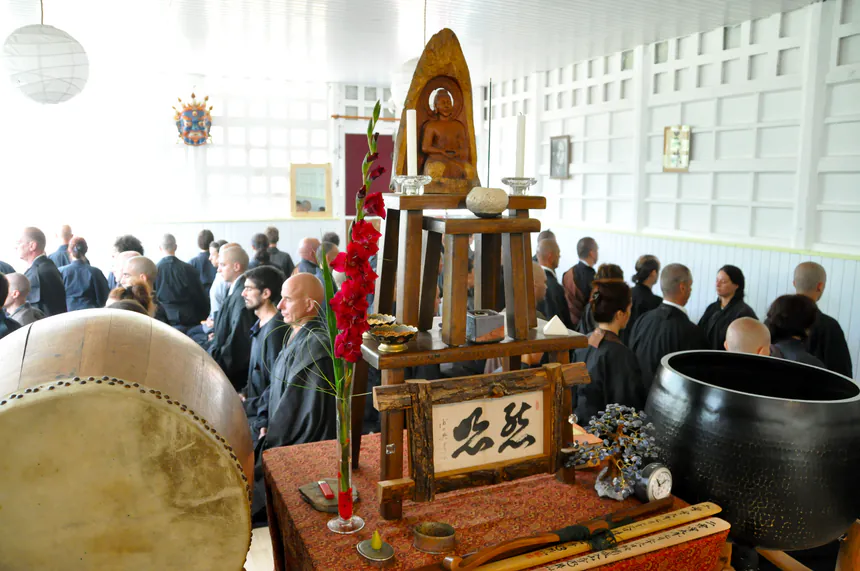
The summer camp is a unique opportunity to deepen the practice of zen for everyone. It is ango, which translates in Japanese as peaceful stay
or dwelling in peace
, an unmissable event for the sangha.
It is a thousand-year-old tradition that we perpetuate every year. It dates back to the time of the Buddha in India, where he retreated with his disciples during the rainy season.
The camp brings together monks, nuns, bodhisattvas, and all those wishing to live an authentic experience at the Yujo Nyusanji zen temple in France or at the Shobogenji zen temple in Argentina.
Crossing the door of a zen temple means choosing to take a break, to withdraw from the turbulence of social life to find calm and serenity, to become intimate with oneself. It is a highlight of the year and a precious parenthesis to fully recharge one’s batteries.
A summer camp is divided into three sessions of about ten days. There is generally a preparation period of five to six days followed by three or four days of sesshin (period of more intense practice).
Each day is punctuated by zazen, participation in the traditional daily tasks of the temples, samu (zen cooking, vegetable garden, maintenance, etc.), but also the sewing of the kesa, do in, shiatsu, yoga, etc.
The summer camp is also about meeting people, reuniting with the sangha, enjoying the fresh air in the mountains for hikes. Playing sports, partying (one evening planned per session), all while being present here and now.


Who can participate?
Like all our zen retreats, the summer camp is open to anyone in good health wishing to discover or deepen the practice of zen meditation (zazen). The rule being to follow the rhythm and not to disturb others.
Of course, a camp being quite demanding, especially for beginners, it is recommended to do an initiation to zazen, zen meditation beforehand, in one of the multiple practice places of our association.
Being a permanent
Every summer, a team of permanents plays an essential role in the life of the camp. They are committed people who stay on site during all sessions and actively contribute to the organization and smooth running of the camp.
Living the experience of a camp as a permanent means engaging in a unique human and spiritual adventure, at the heart of zen practice. It also means benefiting from a special rate for the stay, in recognition of one’s commitment.
It is an opportunity to immerse oneself in the life of the temple, to contribute to the preparations in a spirit of presence, and to share simple and profound moments.


For more information and to register, check the conditions according to the summer camp, the next one at the Yujo Nyusanji temple can be found on this page.
Beginners are welcome! Senior practitioners will be there to guide you. No prior experience is necessary. The only condition required: come with a real spiritual motivation, good humor, and the desire to live a rich experience in a zen temple.
Permanents must arrive one day before the start of the first session and leave one day after the last to help prepare and tidy up the temple.
Receiving ordination
The ordinations of bodhisattva, monk, and nun take place at the end of the camp, during the sesshin of the 3rd session.

Video testimonials
Regular practitioners of zen summer camps, starting with our dear Master Kosen, share their vision of the camp and what they particularly appreciate:
Master Pierre Soko Leroux
(Leads the 1st session, 2026 edition)
Master Pierre Soko Leroux has been a zen monk since 1986. He settled in Barcelona in 1999 and co-founded the Ryokan zen Dojo there.
In 2009 he received the transmission (shiho) from the hands of Master Kosen. He has been transmitting the practice of zen since 2013 in Mexico and since 2016 in Chile. He leads meditation sessions in Europe, Chile, Mexico, and Argentina.
Master Christophe Ryurin Desmur
(Leads the 2nd session, 2026 edition)
Christophe Ryurin Desmur has been a zen monk since 1989 and is responsible for the practice of zen in Lyon.
A teacher of Chinese calligraphy, he is the official calligrapher of the Zen Deshimaru association.
He received the shiho from the hands of Master Kosen on October 8, 2009.
Master Paula Reikiku Femenias
(Leads the 3rd session, 2026 edition)
Master Paula Reikiku Femenias started zazen in 1990 in Sweden. For years, she followed Master Kosen in Amsterdam and Montpellier. She received the transmission, the shiho, from the hands of Master Kosen in 2015.
Since 2011, she has been back in Sweden where she leads a zazen group. Paula is married and a mother of two children. She works and continues the practice at the Yujo Nyusanji zen temple.
Teaching of Master Kosen on the summer camp
The goal of the summer camp, the object of the summer camp, is to be able to deepen the practice of zazen. We repeat all the time:
— In zen, there is no goal.
It is very important to define one’s goal. Why am I doing this? Why am I coming here? And I realize that many people aim for one thing and go in another direction.
So, the summer camp is desiring (we say that we must not have desire, but we must know what we desire!), it is desiring to practice zazen more deeply, more intensely, and for beginners, to discover what zazen is.
So, when we want to obtain something, we must not turn away from our goal, start looking in one direction, then look elsewhere, change direction and then say to ourselves:
— Ah well no, that’s what I want.
Without that, we can never obtain anything.
So, first define one’s goal, one’s desire, and then give oneself all the possibilities to achieve it. The summer camp is trying to give oneself the maximum possibilities to practice zazen in the best conditions. We must favor that and try to find the way in which we will be the best possible.
It must be well understood that for example, here, the food is good, healthy, mostly vegetarian, cooked by people who know a little about dietetics, but we do not come here to stuff our faces. We can use this food to help us in the practice. If we eat too much, it will bother us, so we will move away from the goal we have set for ourselves.
Among the people who have come, a bit from all countries, some will interest us more than others. We have the opportunity to meet, to know each other, to have the pleasure of the company of other interesting, friendly people and what is more, who apparently have the same goal as us, since they also come to practice zen. But we did not come here to meet people.
Sometimes, we come as a family, because it is the best possibility for us to come, because we cannot leave the children. Sometimes even, spouses, who are not passionate about zazen, accompany their wife or husband, they come to favor the practice of their partner, it is very generous. So, sometimes, we come with the husband, the wife, the children, but we do not come to spend a family vacation, we bring the family because it is the best way for us to be able to practice zazen.
So everything is like that, during the summer camp. We are free.
If the confrontation with yourself is a bit difficult, you can smoke, a good cigarette can relax you. There is even a bar, a little music to dance, to possibly remove the tensions generated by zazen. We can even drink a little alcohol. Everything is at our disposal, but obviously, we did not come here to go to the bar or a nightclub or to find a sexual partner.
In fact, we could keep only the dojo and erase all the rest. Only zazen in the dojo is important here. During this month of August, we truly have the opportunity to discover and deepen the practice. And even outside of zazen, we are still focused on zazen. We prepare ourselves, we put ourselves in the best conditions, we can get massages, do yoga.
Master Kosen during the 2003 summer camp.